blog / · updated · 10 min read
Risk management without the spreadsheet theatre
What risk management is, why it matters and the basic vocabulary, from probability and impact to the risk register and the four ways to treat a risk. It's the first part of a series on risk management.
Most companies have a risk register. In many of them it’s a spreadsheet that someone updates the week before the audit, the auditor looks at it, everyone nods, and it goes back to sleep for another year. Meanwhile the real decisions get made somewhere else. Which supplier to choose, whether to accept a client’s security demands, whether to spend the budget on a SIEM or on more backups.
That’s a waste, because risk management done properly is the tool that should inform exactly those decisions. This is the first article of a short series on the subject. Here I cover what it is, why it matters and the vocabulary. The second article covers the theory and the main methodologies, the third proposes a simple method that a small or mid-sized company can actually run, and the fourth packages that method as a procedure template with an example register.
What risk management is
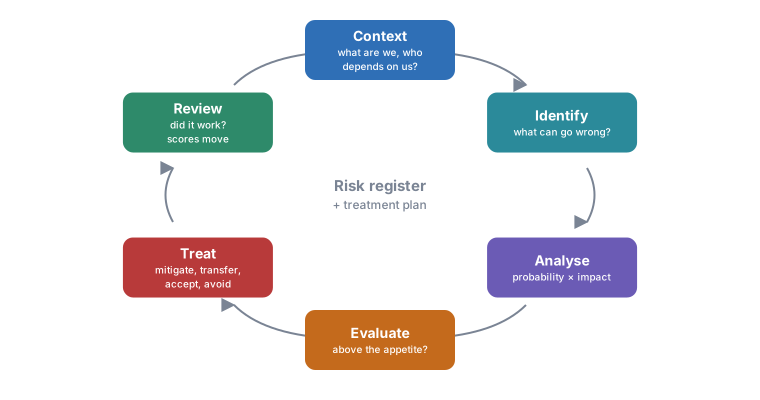
Stripped of jargon, risk management answers three questions:
- What can go wrong?
- How much would it matter?
- What are we going to do about it?
That’s it. Everything else (matrices, scores, catalogues, tools) exists to answer those three questions consistently, so that two different people reach similar conclusions and the answers can be compared from one year to the next.
Risk never goes away
Let’s get the uncomfortable bit out of the way first. Risk is unavoidable. Every company that stores data, depends on suppliers, employs people or ships software carries risk. You can reduce it, move part of it to someone else or decide to live with it. You can’t make it disappear, and whatever is left over is called the residual risk.
Zero risk doesn’t exist, so the goal is no surprises. A risk you’ve identified, scored and decided on is a known quantity. A risk nobody looked at is the one that turns a bad week into a catastrophe. Risk management won’t prevent every bad thing, and sooner or later something nobody saw coming will happen. What it does is make those surprises rarer, and make sure that when one arrives, you already have backups, a recovery plan and someone who knows what to do.
For this to work, the model has to represent your operational reality, with your real assets, your real suppliers and your real weaknesses. A risk register copied from a template describes some other company.
Why it matters
It helps you decide
A company never has enough money or people to fix everything. Risk management is how you choose. If you have budget for one project this quarter, the risk register should tell you which one reduces the most risk for the money. If a client asks you to sign a contract with demanding security clauses, the register should tell you how far you are from meeting them and what it would cost.
That’s why I like to describe it as a business enabler. Its job is to say “yes, and this is what it takes”, or “yes, and we accept this residual risk knowingly”. A company that knows its risks can take more of them, because it takes them on purpose.
It gives you a common language with management
Technical teams talk about CVEs, patch levels and misconfigured buckets. Management talks about revenue, clients, deadlines and reputation. A risk expressed as “probability likely, impact we lose our largest client” is something both sides understand. The risk register is where those two languages meet.
Someone is going to ask for it
ISO 27001, the Spanish ENS, DORA, NIS2, client security questionnaires and cyber insurers all ask some version of “show me your risk assessment”. If it already exists and reflects reality, answering is trivial. If it doesn’t, you’ll build one in a hurry, and it’ll be the kind that collects dust.
Luckily, ISO 27001 requires risk management but doesn’t tell you how to do it. There’s no mandatory method, no mandatory tool and no mandatory number of risks. What it asks is that you define a method, document it, apply it consistently and keep the evidence. You don’t need to complicate your life. A simple, documented method that you actually follow beats a sophisticated one that nobody applies. The second article covers the few things the standard does insist on.
Where risks come from
Risks come from looking at the organisation and its surroundings:
- External factors such as the market, regulation, technology trends, the economy and competitors.
- Internal factors such as people, processes, technology, finances and culture.
- Actors, also called interested parties, such as clients, regulators, suppliers, investors and employees. Each of them expects something from you, and failing those expectations is a risk.
There are formal techniques for this (PESTEL, SWOT, stakeholder mapping), and I cover them in the second article. For now it’s enough to know that a good risk list starts with understanding the context. A list of threats copied from the internet is a poor substitute.
The vocabulary
These are the terms you’ll find in any risk methodology. They’re simpler than they sound.
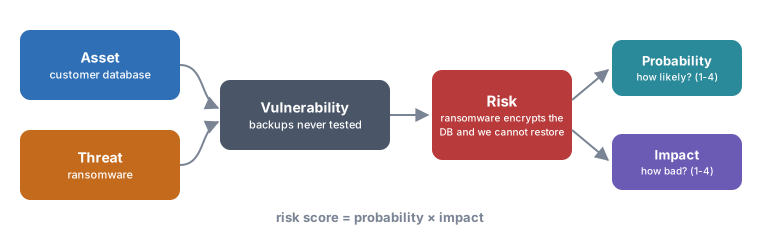
| Term | What it means | Example |
|---|---|---|
| Asset | Anything of value that you need to protect | The customer database, the production platform, a key employee |
| Threat | Something that could happen and cause harm | Ransomware, a cloud outage, an employee leaving |
| Vulnerability | The weakness that lets the threat cause harm | No MFA on the VPN, backups never tested |
| Probability (likelihood) | How likely it is that the threat materialises | Unlikely, possible, likely, almost certain |
| Exposure (optional) | How often the situation that enables the threat occurs | Daily, monthly, once a year |
| Impact | How bad it would be if it happened | Minor, significant, severe |
| Risk score | Probability × impact (× exposure, if used) | 3 × 4 = 12 |
| Risk owner | The person accountable for the risk and for deciding what to do about it | The CTO for platform risks |
What we’re protecting, the CIA triad
In information security you measure impact against three properties of information, known as the CIA triad.
- Confidentiality means only the right people can see it. When it fails you get a data leak, exposed client records or source code on a public repository.
- Integrity means it’s correct and nobody has altered it. When it fails you get a tampered transaction, a corrupted database or a modified invoice with a different bank account.
- Availability means it’s there when you need it. When it fails you get an outage, ransomware or a SaaS provider that goes down.
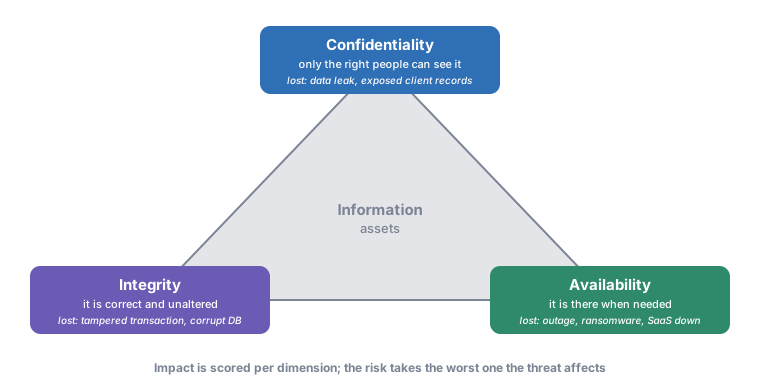
Every threat attacks one or more of these. A DDoS hits availability, and a leak hits confidentiality. Ransomware hits availability and, increasingly, confidentiality too, because attackers now steal the data before encrypting it. When you score impact, you ask how bad it would be for confidentiality, integrity and availability, and you usually keep the worst of the three. Some frameworks add more dimensions, such as authenticity and traceability in Spain’s MAGERIT, or privacy, but CIA is the core everyone shares.
The risk matrix
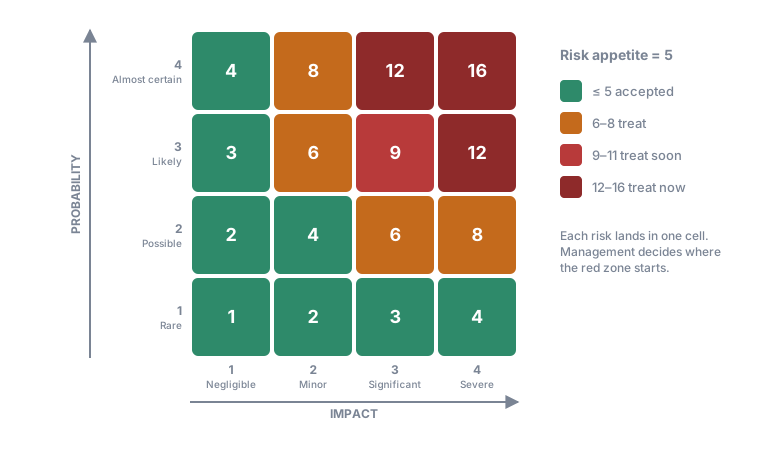
The classic way to visualise risk is a matrix with probability on one axis and impact on the other. A 4×4 matrix is usually enough.
 Unfortunately, no one can be told what the risk matrix is. You have to see it for yourself.
Each risk lands in a cell. The cells in the top right are the ones that keep you awake.
Risk appetite
The risk appetite is the amount of risk the organisation is willing to live with. It works as a threshold on the matrix. Everything above it is uncomfortable and needs treatment, and everything below it is accepted.
The important part is that the appetite is a decision. Management sets it, and it can change. A startup chasing growth may tolerate a score of 10. The same company, once it signs its first bank as a client, may decide that anything above 5 is unacceptable. Lowering the threshold moves the red zone of the matrix and turns some accepted risks into risks that need a plan. That’s exactly how it should work.
Inherent and residual risk
- Inherent risk is the risk before any controls, the raw exposure.
- Residual risk (or current risk) is what remains after the controls you have in place.
The difference between the two is the value your security programme delivers. If you can’t show that difference, you can’t justify your budget.
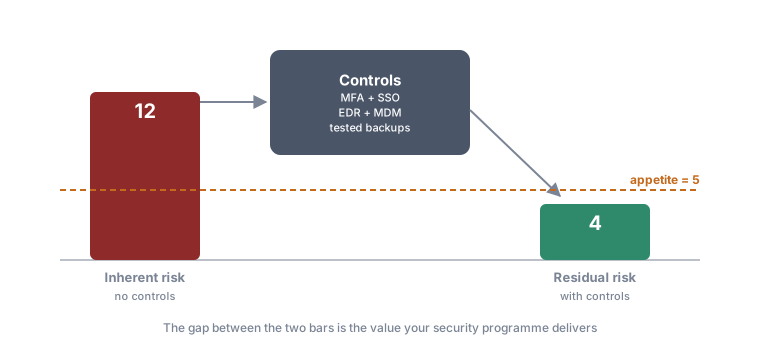
The risk register
The risk register is the list of identified risks, each with its score, owner, controls and treatment decision. It can be a spreadsheet, a Jira project or a dedicated tool. The format matters much less than keeping it alive.
The annual analysis and the treatment plan
Most frameworks ask for a full risk analysis at least once a year, and whenever something important changes. The output is the updated register and a risk treatment plan, which lists the actions that will bring the uncomfortable risks back below the appetite, with owners and dates.
The four ways to treat a risk
For every risk above the appetite, someone has to choose one of four options.
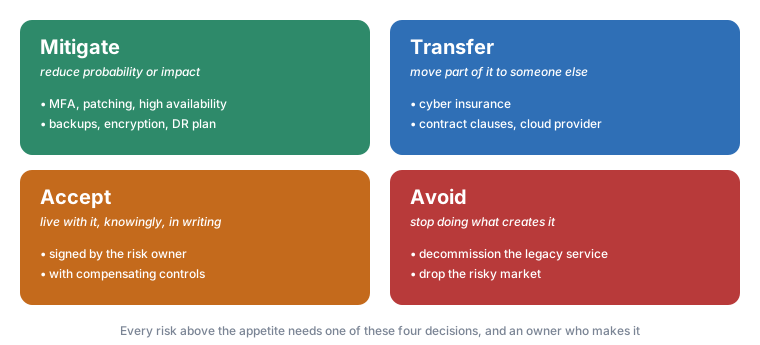
| Option | What it means | Example |
|---|---|---|
| Mitigate | Implement controls that reduce probability or impact | Enable MFA to reduce the probability of account takeover; test backups to reduce the impact of ransomware |
| Transfer | Move part of the risk to someone else | Cyber insurance; contractual clauses with a supplier; using a cloud provider under a shared responsibility model |
| Accept | Live with it, knowingly and in writing | Web filtering isn’t feasible for a fully remote team, so the risk is accepted with compensating controls |
| Avoid | Stop doing the thing that creates the risk | Drop a legacy service nobody uses but which exposes customer data |
Two things to keep in mind:
- Accepting is legitimate as long as the right person documents the decision. Otherwise it’s just a polite way of saying “we did nothing”.
- Mitigation works on two levers. Some controls make the bad thing less likely, such as high availability, patching, MFA and training. Others make it hurt less when it happens, such as backups, disaster recovery, encryption and segmentation. Knowing which lever a control pulls is what lets you update the score honestly.
Risk management should reflect reality
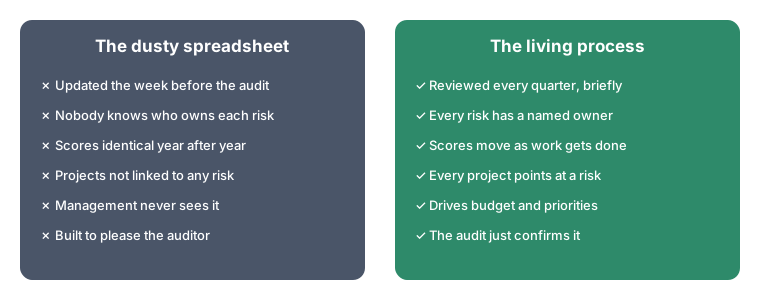
There’s a simple test for a useful risk process. Does it change anything?
 Take the blue pill and the spreadsheet sleeps until the next audit. Take the red pill and you find out how deep the risk register goes.
- Every security project should be able to point at the risk it reduces. If it can’t, why are you doing it?
- Every important risk should have a project, an accepted decision or a very good reason.
- Every risk owner should know they own the risk.
- The scores should move over time, because you’re implementing things. A register where nothing changes from one year to the next is either a sign of perfection or, far more likely, a sign that nobody is looking at it.
When risk management works like this, the annual analysis becomes a quick confirmation of what you already know, rather than an archaeology exercise.
A good risk analysis is about agreeing with management on what could hurt the business most and what you’re going to do about it. Precision matters much less.
Next
This was the gentle part. In the next article I go through the theory you need to do this properly. That means how to analyse the context, where the probability × impact formula comes from (spoiler, it’s a 1971 paper on industrial safety), and how MAGERIT, PILAR, ISO 27005, NIST and FAIR compare.